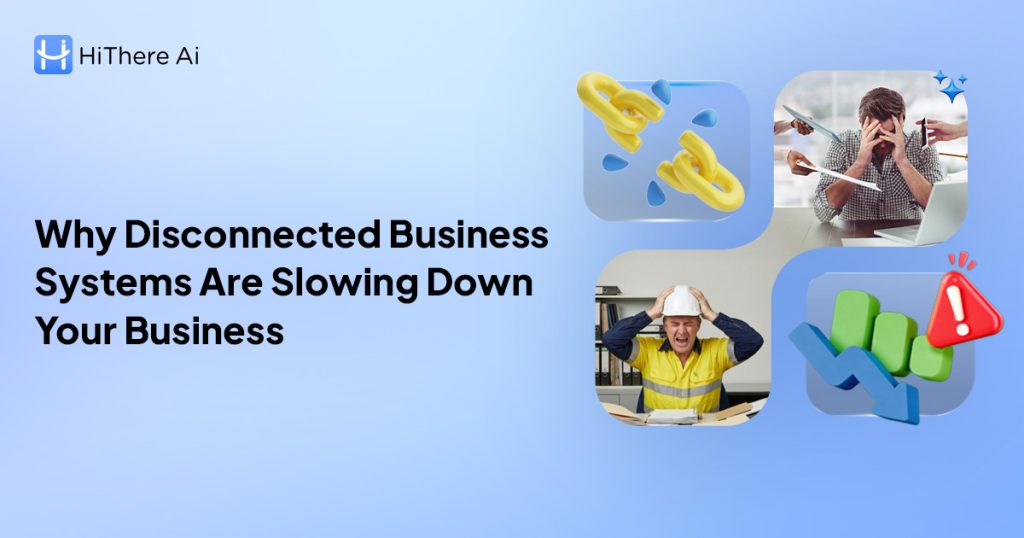
Modern businesses rarely struggle because they lack tools, capability, or demand. In most cases, the real issue is structural. Their disconnected business systems are not working together as a single operational flow.
CRMs do not talk to booking platforms. Communication tools sit outside customer data. Follow ups rely on manual coordination across multiple systems. This is especially relevant for small and mid sized service based businesses operating in Australia, where many teams rely on multiple disconnected software tools to manage daily operations.
As businesses grow, these gaps do not disappear. They grow.
What looks like a well built tool stack is often a fragmented operational system underneath.
Why Disconnected Business Systems Are Breaking Modern Businesses
Most small to mid sized businesses run on multiple software tools. A CRM for customer data, a booking system for scheduling, messaging tools for communication, invoicing platforms for billing. Each tool solves a specific problem.
Individually, they work well. But collectively, they rarely form a complete system.
The issue is not the tools.
It is the lack of connection between them.
Without integration, information does not flow properly across the business. Teams rely on manual processes, repeated data entry, and constant switching between platforms. Over time, this creates structural inefficiency that is difficult to see but easy to feel in day to day operations.
This is common across Australian service based businesses, where tools are often adopted incrementally without a unified system strategy.
The Real Gap Between Business Tools And Workflows
The biggest inefficiencies are rarely inside individual tools. They exist between them.
For example:
- A lead is captured in a CRM but is not reflected in the booking system
- A customer enquiry is handled in a messaging tool but never logged in the system of record
- Sales activity is tracked separately from operational execution
Each system holds part of the truth, but no system holds the full context.
This creates a persistent operational gap where decisions are made with incomplete or delayed information.
In practice, teams are not working from a single source of truth. They are working across multiple disconnected systems.
In many Australian small businesses, this results in teams relying on manual coordination between CRM, booking, and communication tools.
How Disconnected Business Systems Lead To Operational Inefficiency
When systems are not integrated, workflows break down in small but expensive ways.
Leads are captured but not consistently followed up. Customer details are re entered across multiple platforms. Responses are delayed because teams need to manually retrieve information from different tools.
The result shows up clearly in business outcomes:
- slower response times
- inconsistent follow ups
- missed or duplicated actions
- reduced visibility across the customer journey
Revenue is not lost because demand is missing. It is lost because execution is disconnected.
For growing Australian businesses, this fragmentation becomes more visible as enquiry volume increases and coordination demands scale.
Why Adding More Tools Does Not Fix The Problem
A common response to inefficiency is to add more software.
A new CRM feature. A better automation tool. Another integration layer.
But in most cases, this increases complexity rather than solving the core issue.
Every additional tool introduces:
- another system to manage
- another integration point to maintain
- another potential failure point in the workflow
Instead of simplifying operations, businesses often end up with a larger and more fragmented stack that is harder to maintain and align.
Adding more disconnected tools increases fragmentation rather than improving operational workflow efficiency.
More tools do not create better systems.
They often increase system fragmentation.
This pattern is particularly common in Australian small and mid sized businesses that scale software usage faster than system design.
The Hidden Cost Of Fragmented Business Systems
The cost of disconnected systems is rarely obvious in financial reports, but it is always present in daily operations.
It shows up as:
- duplicated administrative work
- manual data transfer between systems
- delayed follow ups and responses
- inconsistent customer experience
- reduced team efficiency due to constant tool switching
The lack of integrated business systems leads to compounding inefficiencies that scale with business growth.
Individually, these issues seem manageable. Collectively, they create a continuous drag on performance.
Over time, this becomes a structural cost that limits scalability even when demand is strong.
Why Businesses Hit An Operational Ceiling With Fragmented Systems
As businesses grow, system fragmentation grows with them.
Increasing customer volume generates more data, enquiries create greater coordination demands, and rising activity often requires multiple tools to operate independently.
Without integration, growth introduces delays across the operation.
Instead of enabling scale, the system becomes the constraint.
Teams spend more time managing tools than improving outcomes.
For many growing Australian service businesses, this is where operations start to feel “busy but inefficient”.
At this point, the problem is no longer operational efficiency.
It becomes system design.
From Tool Stacking To System Thinking With A Unified Platform
At a certain stage of growth, adding more tools stops solving problems and starts creating operational fragmentation.
The shift required is not more software. It is a different operating model.
Instead of managing disconnected tools, businesses need to operate within a unified system layer where communication, customer data, and workflows are connected in real time.
This is where HiThere AI fits in.
HiThere AI functions as a unified business communication and workflow system that connects operational processes into a single structured flow. At the centre of this system is iHub CRM, which acts as the unified data layer for all customer interactions and operational records.
Rather than relying on separate tools for communication, data capture, and follow ups, HiThere AI brings everything into one connected system. Every interaction is captured, structured, and stored directly in iHub CRM, reducing fragmentation and improving operational visibility across the business.
For service based businesses, this means fewer disconnected tools and a more consistent flow from enquiry to execution.
What Changes When Your Business Runs On One Unified System
When business systems are connected into a single operational flow, the impact is immediate.
- Fewer gaps between enquiry and response
- A single source of truth inside iHub CRM
- Faster execution across workflows
- Reduced manual coordination between tools
- More consistent and structured lead handling
The key shift is not about adopting more tools or more automation.
It is about execution through system alignment.
When HiThere AI manages communication and iHub CRM centralises customer data, businesses operate from one connected system instead of multiple disconnected platforms, as seen in how HiThere AI works in real business workflows.
This is particularly important for Australian service based businesses, where speed, coordination, and visibility directly impact revenue outcomes.
Recommended Reads: What Missed Calls Are Really Costing Small Businesses in Australia
Key Takeaways
This is not a discussion about software tools.
It is a structural issue in how modern businesses operate.
Disconnected tools, fragmented workflows, and manual coordination create invisible inefficiencies that compound over time.
The lack of business software integration across systems is often the root cause of these inefficiencies.
As businesses grow, especially in competitive markets such as Australia, these inefficiencies become harder to manage and more expensive to ignore.
In many cases, businesses address this by moving toward a unified system layer such as HiThere AI, which connects communication, workflows, and customer data into a single operational structure powered by iHub CRM as the central system of record.
The core insight is simple.
Businesses do not lose performance because of capability.
They lose performance because their systems are not connected.
Frequently Asked Questions
Disconnected business systems are tools and workflows that operate independently without integration, creating gaps in data flow and operational efficiency.
Most businesses adopt tools incrementally to solve immediate problems, which leads to fragmented systems over time rather than integrated business systems. In many cases, this fragmentation is later addressed by moving toward unified system layers such as HiThere AI, which connects communication, workflows, and customer operations into a single structure powered by iHub CRM as the central data laye
Common issues include missed follow ups, duplicated work, inconsistent data, delayed responses, and reduced operational visibility.
They slow down workflows, increase manual effort, and create gaps in communication and data flow between teams and systems. In more structured operational environments, platforms like HiThere AI help reduce these inefficiencies by centralising communication flows and ensuring all interactions are captured and tracked within iHub CRM in real time.
By moving from tool based operations to a unified system approach where communication, data, and workflows are connected in real time. This is where HiThere AI helps businesses transition away from fragmented tools by bringing communication and operational workflows into a single connected system.